
AI deep research, directed by our long experience, have allowed the creation of (almost) unique articles in addition to established a peer reviewed works
- Details
- Written by: J C Burke
- Hits: 9650
This report expands on the Location of DevelopmentLocation of Development series of research examining the location of approved planning applications for major residential developments across England. Using new data sources, this research seeks to explore the accessibility of these new developments to a variety of different amenities.
You can download the report here or read in full below
Report authors
Samuel Spencer, RTPI Policy and Data Analyst
David Pendlebury, MSc
Acknowledgements

This report has been made possible thanks to the use of transport data originating from the Department of Transport (DfT) and provided by the National Audit Office (NAO) as well as thanks to a private database of planning approvals that was curated and made available by LandTech.
Executive Summary
This report builds on the Royal Town Planning Institute’s Location of Development work series commenced in 2015. This third report analyses planning permissions granted between 2015-2019 in England.
The location of new development, defined in this report as recent planning permissions for new major residential housing, can significantly impact accessibility to key amenities for residents across England in several ways including:
- Access to amenities that support economic opportunities, healthcare services, and educational facilities varies widely by location and mode of transport or new planned developments.
- In locations with a major agglomeration of jobs such as London and the North West, reaching key amenities by public transport takes less than an hour. In other regions, a comparable journey can take nearly twice as long.
- This research highlights the stark differences across England. For example, in the 10% most accessible planned developments, access to jobs and educational facilities will be within a 30-minute walk. In the 10% least accessible planned developments, access to the same facilities will be over 90 minutes walking time away.
- We analysed new residential developments in England based on the location of planning permissions approved between 2015 and 2019. This showed that access to amenities from these locations is twice as fast by car compared to public transport, and nearly three times quicker than by walking. Average public transport travel times to hospitals or large employment centres were also comparable or slower than walking, which may not be a realistic option for all residents of these new developments.
The impacts of such diversity in the location of development are potentially severe and wide ranging. This report recognises that some individuals will make a personal choice to live in more isolated locations. However, there is a significant proportion of planned development and major housing sites which be poorly connected to key amenities by any modes, including the most sustainable, healthy and affordable transport options.
This impacts on those who live in the least accessible of new developments in multiple ways. They will have less access to economic opportunity, reduced access to - and choice of - healthcare and educational provision, and fewer options to choose their mode of travel.
Where there exists a positive link between accessibility to key services and house prices, a lack of accessibility will serve to widen economic and health inequalities. New communities with poor accessibility encourage private vehicle dependent travel, which undermines initiatives to encourage sustainable transport use in line with net zero objectives and promote healthy lifestyles.
- Details
- Written by: J C Burke
- Hits: 15538
What are Passivhaus Standard Requirements?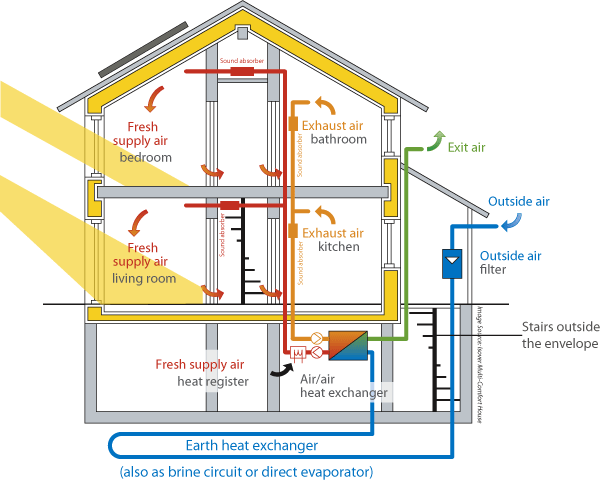
The requirements for a home to meet Passivhaus Standards. The Passive House Institute detail these as follows:
- Space Heating Energy Demand should not exceed 15 kWh per m2 of net living space per year.
- The Renewable Primary Energy Demand, the total energy to be required for all of your home’s domestic applications, must not exceed 60 kWh per m2 per annum.
- For Air-tightness, a maximum of 0.6 air changes per hour is allowed at 50 Pascals pressure (ACH50). This will be verified with an onsite pressure test.
- Thermal comfort should be met for all living areas for energy-efficient houses in both summer and winter seasons. This shouldn’t exceed 25°c for any more than 10% of the hours in a year.
- The "fabric first" concept of making sure the property is heavily insulated, is paramount - and generally to a much higher standard than current UK Building Regulations.
See our detailed blog regarding Passive House Standards as defined in the US/UK CLICK HERE
The image indicates the mechanical ventilation system [red and blue circuits] - in this example the fresh incoming air has been routed under the basement to pick up some 'heat' from the earth [in the winter] and to cool this same air in the summer - "Earth Heat Exchanger" A further method to reduce the total energy requirement of this design.
Also indicated is the summer sun entering the building via the windows, with suitable shading {roof overhangs] to prevent over-heating in the summer. However in winter, the lower sun will penetrate deeper into the structure, thus giving a valuable solar gain in these colder months.
The Basement will also be used for rainwater harvesting - to be filtered and used for flushing toilets and even bathing and showering etc. Thus reducing the cost of drinking water into the property.
- Details
- Written by: J C Burke
- Hits: 14419
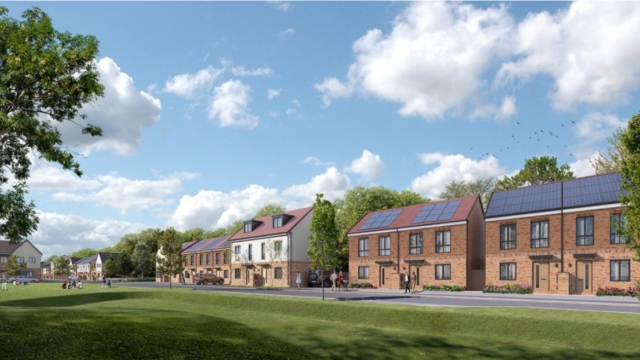 Octopus Energy and a housebuilder have entered into a partnership to roll out the UK’s first homes to guarantee residents Zero Energy Bills. The construction of the properties was first announced in February of this year but now it has been revealed that Octopus Energy will be providing a bespoke tariff as part of the project.
These homes will come equipped with an air source heat pump, solar panels and battery storage technology. Alternatively they could also be additionally “powered by wind turbines and bio-methane powered CHP for district heating systems. Either way Octopus gets embedded power supplies with zero capital costs.
These energy efficient technologies will combine to provide “free”, clean energy around the clock, with Octopus Energy providing a tariff specifically for those living there. Octopus will also sell on the ‘surplus’ [over and above any battery storage] electricity so generated to its customers – as low cost power – thus averaging down their cost of electricity into the bargain
How many of the homes
There is no real limit to numbers in this important ‘marriage’ of construction and Energy partnership, just the finance and will power to encourage such schemes as ‘normal’.
Many of these homes will be “zero-carbon (dioxide)” in operation, meaning they can generate their own sources of energy {heating, Hot Water and Electricity], helping to reduce emissions produced by ‘normal’ domestic utilities such as electricity and heating. These concepts can also be extended to Commercial and Industrial properties.