
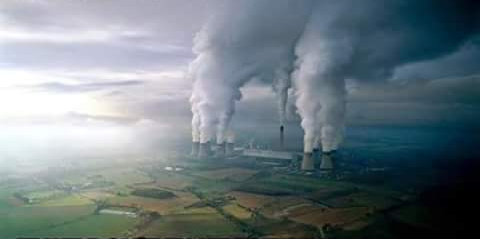
 DRAX - What Colour Elephant is this - White, Black or Wood Veneer?
Preamble
This appraisal follows on from DRAX and Dirty Secrets: A 50-Year Testament to Thermodynamic Waste, published on Sun Earth Energy on 12 February 2026. That article has had 664 reads to date.
The earlier piece is written from direct industrial experience. In 1975 the author was on placement with Norwest Holst in Leeds, planning the cooling towers for the new Drax station, which was built on the Selby coalfield to burn its coal. Around 1979–80, as tender planning engineer for Turriff Construction (Warwick), he delivered the bid for the Selby coalfield's above-ground works to NCB headquarters. He then drove back to Warwick through heavy snow, reaching the M1 just before it was closed. That article set out the long view: centralised power stations that dump most of their fuel energy as waste heat, the acid rain Yorkshire coal sent to Scandinavia, and the case for decentralised combined heat and power.
This document narrows the focus to the financial and carbon accounting of the coal-to-biomass conversion. It updates the figures with data published since February: 2025 subsidies of £999m, cumulative support of £8.72bn, the signed 2027–31 contract, and Drax's retreat from carbon capture (BECCS).
Updates to figures in the February article: the post-2027 support is a four-year contract to March 2031 at roughly half the previous subsidy, not an extension to 2035. Cumulative subsidies to the end of 2025 are £8.72bn, against the earlier figure of about £7bn.
Bottom line
The economic case for converting Drax only holds if two assumptions are both true: the counterfactual is coal, and forest regrowth cancels stack emissions quickly. Relax either and consumers have paid roughly £9bn for little or negative climate benefit.
- Money: £8.72bn in RO and CfD payments 2012–2025, a record £999m in 2025 alone, plus an ETS exemption, a Treasury-guaranteed loan and a new 2027–31 contract (Ember).
- Carbon:1 MtCO2e from the stack in 2025, the UK's largest point source for the eleventh year running, but booked as zero in UK statistics (Ember).
- Physics: per MWh, wood emits about as much CO2 at the stack as coal, and more fuel mass must be burned. The "saving" is an accounting convention, not a chimney measurement.
- The promised fix is gone: BECCS, the justification for bridging subsidies, was impaired in Drax's 2025 results and is effectively shelved.
On your Selby coal point: you are right that the "local resources" logic was ignored. But reopening Selby would not have been the better answer: the complex closed in 2004 on losses and geology, and coal emissions cannot be offset by regrowth at all. The real missed counterfactual is gas plus renewables and storage, not coal. Sections 5 and 6 test this in detail.
1. The support ledger
Direct cash support reached £8.72bn by end-2025; counting implicit support and contracted future payments, the public bill is well above £10bn.
|
Support stream |
Amount |
Period |
Notes |
|
Renewables Obligation (units 2–4) |
£728m in 2025 |
2013–Mar 2027 |
Worth about £70/MWh; RPI-indexed, so it rose 10% a year for two years (Ember) |
|
CfD (unit 1) |
£271m in 2025 |
2014–Mar 2027 |
Average top-up about £54/MWh (GreentechLead) |
|
Cumulative RO + CfD |
£8.72bn |
2012–2025 |
About £13 per household in 2025 alone (Ember) |
|
New dispatchable CfD, all 4 units |
Strike £109.90/MWh (2012 prices) |
Apr 2027–Mar 2031 |
Capped at about 6 TWh/yr (27% load factor); projected to halve the subsidy (Bloomberg, DESNZ to committee) |
|
UK ETS exemption |
Implicit |
Ongoing |
Biomass stack CO2 is outside the UK ETS. At an approximate £40–50/t, 14.1 Mt would cost roughly £0.6–0.7bn a year |
|
Conversion finance |
£75m Treasury-guaranteed loan; £100m Green Investment Bank facility (half later replaced) |
2012–2013 |
Supported a £650–700m conversion; the guarantee drew an EU state-aid complaint (Process Engineering, edie) |
|
Proposed BECCS support |
~£30bn (Ember estimate) |
2030s |
More than the entire UK CCS budget; now shelved (section 7) |
Context: the NAO counted £22bn of biomass support across all schemes from 2002 to 2023, with Drax taking about 36% (City AM).
The 2027–31 strike price equals about £155/MWh in 2023–24 money at the original £113 level. That is well above recent offshore wind auction prices, and Drax only receives it on the hours the collar allows.
2. Where the "hidden" carbon goes
The carbon is not hidden from the atmosphere; it is hidden by the accounting boundary. Three ledgers each see only part of it.
|
Ledger |
What it records for Drax |
What it misses |
|
UK greenhouse gas inventory and UK ETS |
Zero for biomass combustion; Drax's own 2024 Scope 1+2 was just 207 ktCO2e (Drax ESG 2024) |
13.3 Mt (2024) and 14.1 Mt (2025) of biogenic stack CO2 |
|
Producer-country land-use (LULUCF) inventories, mainly Canada and US |
Harvest is meant to appear as a fall in forest carbon stock |
Harvest for export can be masked by aggregate national forest growth; it is never attributed to UK electricity |
|
UK sustainability criteria |
Supply-chain emissions (harvest, drying, pelleting, rail, shipping) against a threshold |
Forest carbon stock change and the carbon payback period |
The scale. Drax's 14.1 Mt in 2025 was four times Pembroke, the second-largest UK emitter at 3.3 Mt. It came from burning 7.5 Mt of wood, over 99% imported, for about 5% of GB power (Ember, CleanTechnica). In 2023 it equalled about 2.9% of UK territorial emissions (Ember).
The supply chain. Drax claims more than 80% savings versus coal, supply chain included (Drax). That claim rests entirely on scoring stack CO2 as zero. A pellet supplier's own figure for the North Carolina-to-Selby chain was 26 gCO2e/MJ of power, about 94 kgCO2e/MWh, with shipping roughly a third (Enviva).
The payback period. Regrowth reabsorbs carbon only over time. MIT/Climate Interactive modelling put payback for central and eastern US forests at 44–104 years (RenewEconomy). Chatham House concluded that, in most cases, woody biomass emits more than coal over relevant timescales (Chatham House). Every year inside that window, the atmosphere carries the extra CO2.
Drax disputes all of this, citing IPCC accounting practice. That rebuttal is correct about the convention, but the IPCC convention is a rule for avoiding double counting between countries. It was never a finding that burning wood has no climate effect.
3. Energy chain: wood versus coal
Your instinct on efficiency is right in substance: per MWh delivered, the wood chain moves more mass, spends more energy before combustion, and emits at least as much CO2 at the stack.
- More fuel mass. Drax planned 7–8 Mt of biomass a year to replace about 5 Mt of coal (Yorkshire Post).
- Stack intensity at least as high. Ember notes pellets have a carbon intensity per unit of fuel equivalent to coal, so more CO2 per kWh (OilPrice). Dividing 14.1 Mt by roughly 14 TWh (5% of GB generation, approximate) gives about 1.0 tCO2/MWh. A coal unit is roughly 0.9, a modern gas CCGT roughly 0.35–0.4 (approximate).
- Energy spent before the boiler. Green wood is around half water. It is dried, hammer-milled and pressed at the mill, railed to port, shipped across the Atlantic, then railed again from port to Selby. That chain added about 94 kgCO2e/MWh in one supplier's figures (section 2).
- Same old turbines. The converted units are 1970s–80s coal-era boilers and turbines. Conversion changed the fuel, not the thermodynamic cycle, so efficiency stayed at coal-plant levels rather than gas-plant levels.
So the physical system is a coal power station fed by a transatlantic forestry supply chain. Its only claim to low carbon is regrowth, timed decades into the future, in someone else's forest.
4. Costs exported off the balance sheet
The "clean-up" costs you mention fall mostly on US pellet-mill communities and on regulators, not on Drax's UK accounts.
|
Date |
Event |
Cost or outcome |
|
Jun 2026 |
FCA closes its investigation into Drax's 2021–23 sourcing disclosures |
No further action (FCA) |
|
Spring 2025 |
Mississippi refuses Drax's request to become a "major source" of hazardous air pollutants at Gloster |
Permit increase denied (Earthjustice) |
|
2024 |
Mississippi fines Gloster for hazardous air pollutants 50% over limit |
$225,000 (Mississippi Today) |
|
Aug 2024 |
Ofgem finds Drax could not support its Canadian forest-profiling data |
£25m redress payment; no ROCs found wrongly issued (Ofgem) |
|
2023 |
Louisiana settlement over VOC emissions at Morehouse and LaSalle mills |
$3.2m, without admitting liability (EIP) |
|
2020 |
Mississippi fines Gloster for VOCs about three times the permit |
$2.5m (Southerly) |
|
2024 |
NAO: government cannot demonstrate biomass meets sustainability criteria |
Assurance relies on generator data and limited audits (Bioenergy Insight) |
Environmental groups also report that Drax's Gloster plant has breached its air permit every year since 2015. Over the same period Drax raised at least $762m in sustainability-linked "green" loans (Mississippi Today, above).
For a fair account: the FCA cleared Drax on investor disclosure, and Ofgem treated the breach as data governance, not fraud. But the fines are trivial against £999m a year of subsidy, and no one prices the health cost to mill communities.
5. The Selby coalfield counterfactual
The Selby argument wins on energy security and local economics, but loses on carbon and on feasibility. It exposes the policy's incoherence without being the right alternative.
What is under the ground. The Barnsley seam was estimated at about 600 Mt, with total reserves near 2,000 Mt; only about 121 Mt was mined in 21 years (Wikipedia/BGS, Railway to Greenway). By that measure it is indeed under-exploited.
Why it closed. UK Coal announced closure in 2002 after continuous losses, with no subsidy. North Selby had already shut in 1997 on geological problems, and the BGS cites geological complications (NMRS). Kellingley, the last deep mine, followed in December 2015.
Where your critique lands:
- Pellets travel roughly 6,000–8,000 km (approximate) to a station sitting on a coalfield. That fails any plain "local resources" test.
- Over 99% of the fuel is imported, so the plant converted a domestic fuel dependency into a foreign one. The UK made only about 0.3 Mt of pellets in 2023, against Drax's 5.8 Mt (Ember).
- The subsidy flows abroad: to Canadian and US forestry, pellet mills and shippers, rather than Yorkshire wages.
Where it does not:
- Coal emits around 0.9 tCO2/MWh with no regrowth credit even in theory. It would also pay the full UK ETS price.
- Reopening flooded, sealed deep mines after 20 years would take years and billions, for a fuel the UK stopped burning for power in 2024.
- The honest comparison is therefore three-way: imported wood, local coal, or gas plus wind, solar and storage. Wood beats coal only under generous accounting; it rarely beats the third option.
6. Stress-testing the economic case
On 2025 numbers, Drax abates carbon at about £90/t only in the most favourable case. Under realistic counterfactuals and timescales it costs £260/t or more, or increases emissions outright.
Method (approximate, for illustration): 2025 subsidy £999m; generation about 14 TWh; stack 1.0 tCO2/MWh; supply chain 0.1; coal 0.90; gas CCGT 0.37. The three accounting cases vary how much stack CO2 is credited back by regrowth before 2050.
|
Accounting case |
Biomass net tCO2/MWh |
vs coal: Mt/yr |
vs coal: subsidy per t |
vs gas: Mt/yr |
vs gas: subsidy per t |
|
A. Official: stack counted as zero |
0.10 |
11.2 saved |
~£89 |
3.8 saved |
~£263 |
|
B. Half of stack repaid by 2050 |
0.60 |
4.2 saved |
~£238 |
3.2 extra |
No abatement |
|
C. Payback beyond 2050 (44–104 yrs) |
1.10 |
2.8 extra |
No abatement |
10.2 extra |
No abatement |
The counterfactual changed in 2015. In 2012–13, the alternative to conversion was arguably coal running to the mid-2020s. Once the government announced the coal phase-out in 2015, the realistic alternative for every later year became gas and renewables. On that basis, even official accounting gives about £263/t.
The externality not paid. In case C versus gas, roughly 10 Mt a year of extra CO2 at an illustrative £250/t is about £2.5bn a year of climate damage. That sits on top of the £1bn subsidy.
The strongest defence. NESO advised that Drax matters for security of supply in 2027–31 (Written statement). Drax cites Baringa analysis claiming £1.6–3.1bn of system savings, but Baringa was commissioned by Drax (AJ Bell). That is a capacity argument, a case for paying for dispatchable megawatts, not for treating the output as low-carbon.
7. The bridge to nowhere: 2027–31 and BECCS
The 2027–31 contract was framed as a bridge to carbon capture; with BECCS impaired and shelved, it is now a bridge with no far bank.
- The contract. Signed November 2025: £109.90/MWh (2012 prices), CPI-indexed, about 6 TWh/yr, 100% sustainable-sourcing requirement with enhanced auditing (AJ Bell). Drax targets £100–200m EBITDA a year from the station under it.
- Emissions still largest in UK. Ember expects stack emissions to fall to about 5.8 MtCO2e, still above any other single UK site to at least 2030 (CleanTechnica).
- BECCS retreat. Drax cut around 100 carbon-capture roles in 2025 (edie). Its 2025 results, published February 2026, impaired UK BECCS development costs and prioritised shorter-term returns (Bioenergy Insight). By April 2026 it was reported to have walked away from the plan, after ministers declined advice to tie the bridging deal to a BECCS commitment (E&E News).
- Even BECCS was doubtful. Ember estimated BECCS at Drax would need about £30bn, more than the whole UK CCS budget. Net removals were contested once supply-chain and forest-carbon effects are counted (Bioenergy Insight).
The net effect: consumers paid a decade of subsidy partly on the promise of negative emissions, and that option has now lapsed.
8. Verdict and what a proper audit would need
Judged as a whole system, the conversion was a coal-plant life extension paid for as climate policy. It may have bought dispatchable capacity, but not demonstrable decarbonisation.
What the evidence supports:
- The subsidy per tonne abated is high even on official accounting once gas, not coal, is the counterfactual.
- Stack emissions are real, large and outside every UK ledger and price signal.
- Local pollution costs and sourcing risk sit offshore, weakly policed by self-reported data.
- The long-term justification (BECCS) has gone, while the 2027–31 payments continue.
Open questions a full audit should answer:
- ☐ Forest carbon stock change in each sourcing area, measured rather than modelled, against a no-pellet-demand baseline.
- ☐ Drax's exact annual generation and its share in high-price, system-stress hours, to value capacity separately from energy.
- ☐ The least-cost alternative for 2.6 GW of dispatchable capacity in 2027–31 (gas peakers, storage, interconnection), on a like-for-like cost per firm MW.
- ☐ Whether producer-country LULUCF inventories actually record Drax-linked harvest emissions.
- ☐ A public, independent version of the Baringa system-savings analysis.
A fair note on uncertainty: forest-carbon outcomes depend heavily on feedstock (sawmill residues versus whole trees) and on what the land would otherwise do. Where pellets truly come from waste that would rot or burn anyway, payback is short. The problem is that UK assurance cannot currently show how much of Drax's fuel is in that category.
Sources
Figures marked "approximate" are estimates or derived calculations, not sourced values.
- Ember: £1bn but falling — record subsidy enters final year (2026)
- Ember: UK's largest emitter Drax reports record emissions in 2025
- Ember: The largest emitters in the UK, annual review (2023 data)
- UK Parliament written statement on Drax 2027–31
- DESNZ letter to committee: heads of terms detail
- Bloomberg: Drax finalises deal (Nov 2025)
- AJ Bell: Drax signs contract heads of terms
- CMA Subsidy Advice Unit referral
- Drax ESG Performance Report 2024
- Ofgem closes investigation into Drax
- FCA closes investigation into Drax (Jun 2026)
- NAO: The government's support for biomass (2024)
- Chatham House: Woody biomass for power and heat
- RenewEconomy on MIT/Climate Interactive payback study
- Enviva supply-chain emissions to Drax
- Environmental Integrity Project: $3.2m Louisiana settlement
- Mississippi Today: pollution violations and green loans
- Earthjustice: pellet manufacturing in the South
- E&E News: Drax pulls out of UK climate plan (Apr 2026)
- Bioenergy Insight: BECCS impairment and permit
- Selby Coalfield (Wikipedia, citing BGS) NMRS: Stillingfleet Mine
- Process Engineering: EU state-aid complaint on Drax loan (2014)